Arabic Font vs Arabic Calligraphy: What's the Difference
If you’ve spent any time searching for Arabic typography online, you’ve probably noticed that “Arabic font” and “Arabic calligraphy” get used as if they mean the same thing. Someone searching for a simple font to use on a website ends up on a page full of calligraphy tutorials and brush techniques, while someone hoping to commission a calligrapher for a wedding gift ends up downloading a font file instead. It’s an easy mix up, and honestly, the two are close enough in appearance that the confusion makes complete sense to anyone who isn’t already familiar with Arabic typography.
But they aren’t the same thing, and understanding the difference actually matters once you’re trying to get real work done, not just browse for inspiration. A wedding invitation, a business logo, a tattoo design, a book cover, and a quick Instagram caption all call for very different approaches, and picking the wrong one can leave a project looking either too stiff and generic or too rough and inconsistent for what it needed. Someone building a brand identity has completely different needs than someone who wants a single, meaningful phrase written beautifully for a frame on the wall, and knowing which category your project falls into saves a lot of wasted time.
This post walks through what separates a font from calligraphy at a basic level, why calligraphy came first and shaped everything that followed it, how the two differ in practice once you actually sit down to use them, and how modern tools have started to blur the line between the two in a way that’s genuinely useful for most everyday projects. By the end, you should have a clear sense of which one fits what you’re trying to make, and why.


Understanding the Two Terms
What an Arabic Font Actually Is
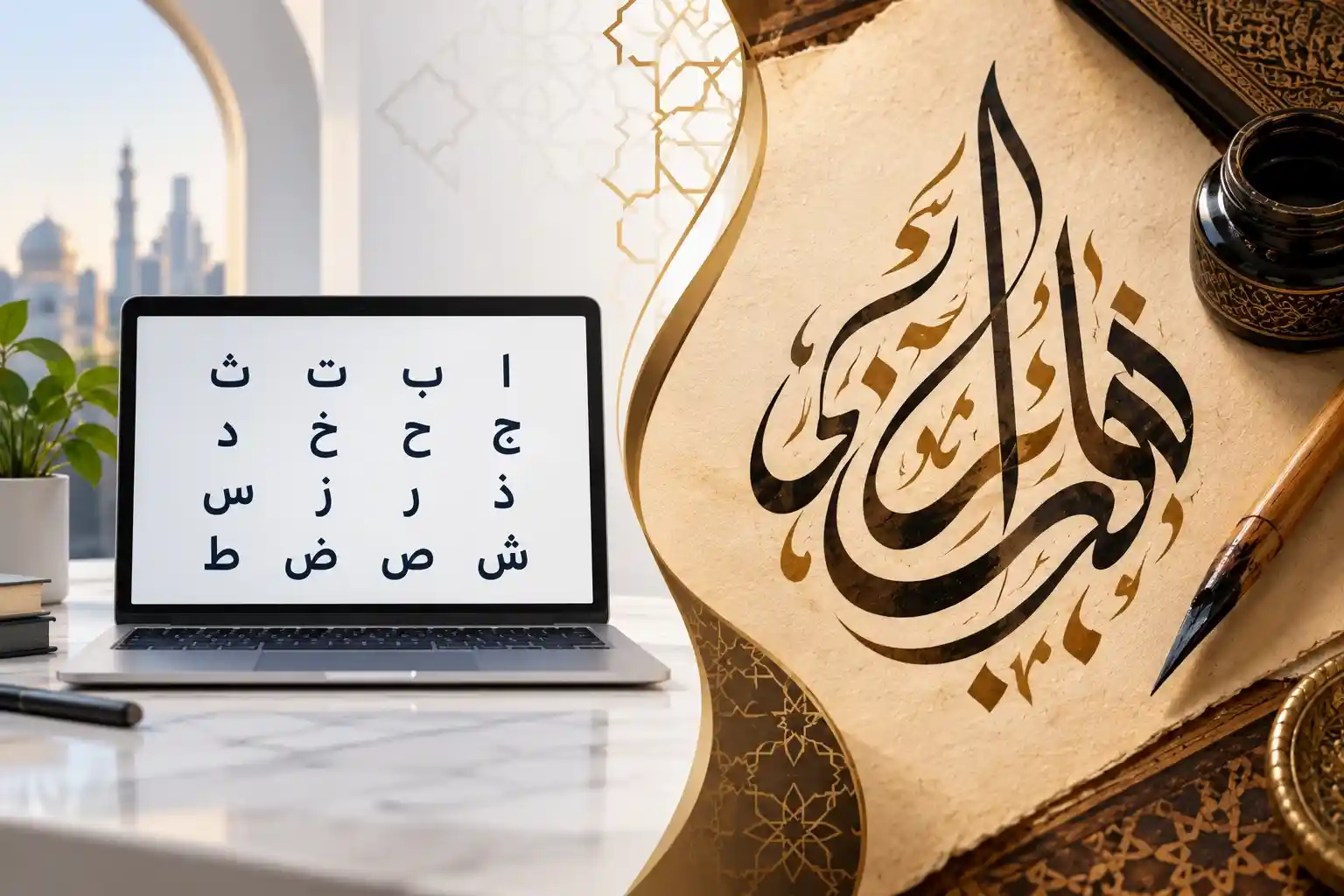
A font is a digital typeface, built once by a designer and then reused exactly the same way every single time someone types with it. Each letter, along with its various connected and isolated forms, since Arabic letters change shape depending on their position in a word, is drawn once and stored as a file that software reads and displays on demand. That file gets installed on a device or loaded by a browser, and from that point on it behaves like any other piece of digital text, meaning it can be resized, recolored, copied, and pasted without ever losing its shape. When you type a name or a short phrase into an Arabic font generator, the tool is simply mapping each character you entered to its matching glyph and stitching the connections together automatically, which is why the output appears almost instantly and looks perfectly consistent no matter who types it, how many times it’s generated, or what device it’s viewed on afterward.
What Arabic Calligraphy Really Means
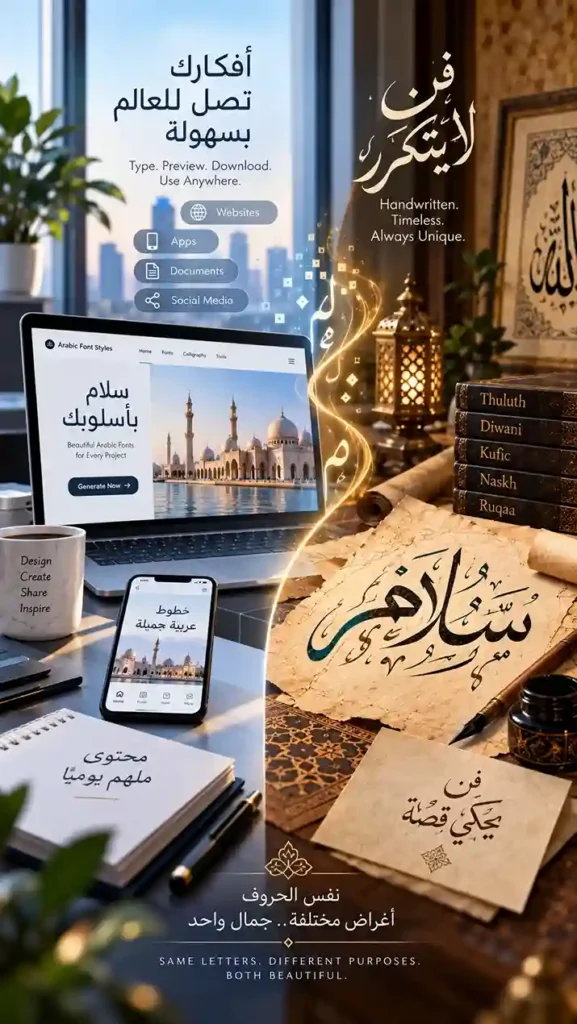
Calligraphy, on the other hand, is a practiced art form passed down through direct instruction rather than a piece of software that anyone can install. It refers to letters formed entirely by hand, traditionally with a reed pen called a qalam that’s cut at an angle to control the thickness of each stroke, following proportion systems that were developed, debated, and refined by scholars and artists over roughly a thousand years. Styles like Thuluth, Diwani, Kufic, Naskh, and Ruqaa each follow their own detailed rules for how thick a stroke should be relative to the size of the letter, how far certain letters should stretch or curve, and how entire words should flow into one another across a page or panel. Because every piece is created stroke by stroke, with a human hand controlling pressure, angle, and speed the whole time, no two pieces of calligraphy ever come out exactly alike, even when the same calligrapher sits down to write the identical phrase twice in a row.
The Arabic font generator lets you
The Arabic font generator lets you type or paste Arabic text and preview it instantly across a range of Arabic font styles — modern, traditional Naskh, Kufi-inspired, handwriting and decorative. Adjust the color, background, size and alignment, then download your design as a high-quality PNG or JPG image.
This tool created-paste text tool instead.
Key Differences Between the Two
- Fonts are typed on a keyboard, calligraphy is drawn slowly by hand
- A font looks identical every time it renders, calligraphy never repeats itself exactly
- Fonts render in seconds on any device, calligraphy can take hours or days to finish
- Fonts follow rules that are already built into the software itself
- Fonts suit logos, websites, apps, and daily social captions without any extra effort
- Calligraphy suits framed art, formal manuscripts, and mosque or building decoration
- Anyone can use a font with zero training or artistic background at all
- A font is simply a digital file, calligraphy is a physical or hand rendered piece of work

Which One Should You Use
For most everyday projects, a font is simply the more practical choice, and there’s no shame in leaning on one. If you’re designing a website, formatting a long document, building an app interface, or putting together dozens of social media posts on a tight deadline, you need something that renders the exact same way across every device and browser without requiring you to hire anyone or wait around for a finished piece.
Speed and consistency matter more than one of a kind uniqueness in those situations, so a digital typeface does the job cleanly without slowing your workflow down, and it can be adjusted, resized, or swapped out in seconds if the design needs to change later.
Where things get genuinely interesting is the middle ground that’s opened up over the past several years thanks to better design tools. A large number of Arabic fonts today are actually built directly from digitized calligraphy, meaning skilled designers trace and refine real calligraphic strokes and turn them into usable typefaces, so the font itself carries the curves, flourishes, and rhythm of Thuluth or Diwani without needing a trained hand to physically produce each new piece. That’s essentially what a tool like arabicfontgenerator.dev makes possible for anyone browsing the web.
You can type a name, a saying, or a short verse, preview it instantly across several scripts that look genuinely handwritten, and download the result in seconds, which gives you a calligraphic feel for gifts, social posts, or personal projects without the cost, scheduling, or waiting period that comes with commissioning an actual artist.
Frequently Asked Questions
Is an Arabic font generator the same thing as calligraphy?
Not exactly, though the line has gotten blurrier over time. A generator uses pre-designed digital letterforms, many of which are modeled closely on traditional calligraphic styles, but the output is still typed rather than hand drawn, so it lacks the tiny irregularities and personal touch a real calligrapher would naturally introduce into every stroke.
Can I use Arabic fonts for religious text like Quran verses?
Yes, many fonts are specifically designed with correct letter proportions and diacritical marks in mind for exactly this purpose, though for formal religious publishing or printed copies of the Quran, it’s still common practice to rely on scripts that have been reviewed and approved by qualified scholars.
Which Arabic font style looks most like calligraphy?
Thuluth and Diwani tend to look the closest to genuine handwritten calligraphy because of their flowing, decorative letterforms and dramatic curves, while Kufic looks noticeably more geometric, angular, and structured, making it better suited to modern logos than to traditional artistic pieces.
Do I need to know Arabic to use an Arabic font generator?
No, most tools let you type in English or another language and translate or transliterate the text into Arabic automatically, so you don’t need to be able to read or write the script yourself to get a usable, accurate result.
Are Arabic calligraphy style fonts free to use commercially?
It depends entirely on the license attached to that specific font, since some are released for personal use only while others allow commercial projects, so it’s always worth checking the terms carefully before using one in a paid product, client project, or branded material.
How long does it take to learn real Arabic calligraphy?
Most traditional training takes several years of consistent, guided practice under an experienced teacher, since each individual script has its own detailed set of proportion rules and muscle memory requirements that simply take time to master properly by hand.