Where It All Began
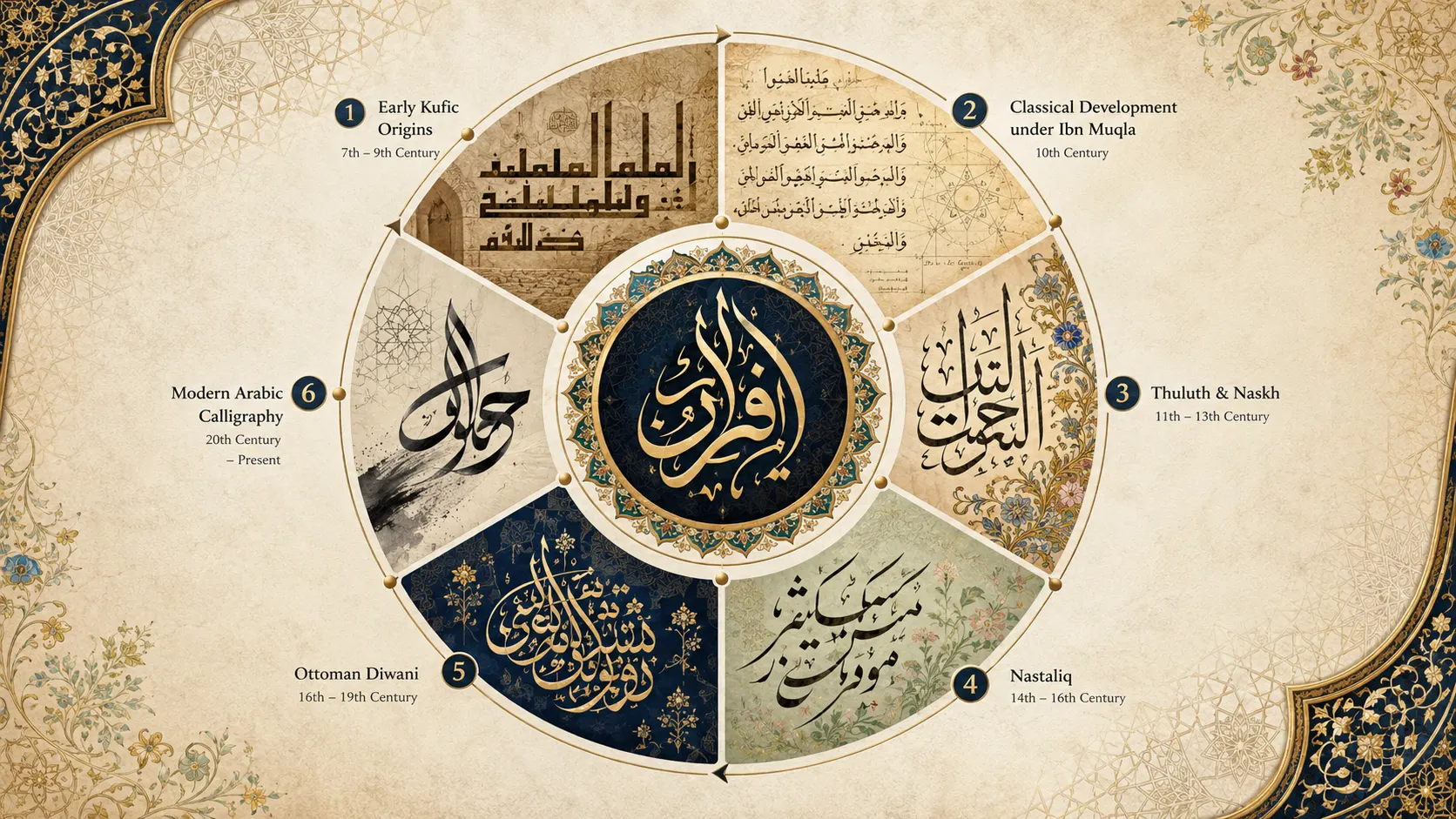
Long before Arabic script could be typed, styled, and downloaded in seconds, it was carried across empires by hand — one reed pen, one scribe, one carefully measured letter at a time. For over a thousand years, calligraphy has been how the Islamic world chose to honor its most sacred text, decorate its buildings, and put its identity into writing. Knowing where it came from makes it a lot easier to appreciate the next time you see it — on a mosque wall, a coin, or a page from an old Qur’an.
Arabic script traces back to Nabataean writing, a cursive form of Aramaic used across the Arabian Peninsula centuries before Islam. It was purely functional at first — used for trade, inscriptions, and the odd verse of poetry — with no fixed dots or vowel marks, so reading it usually meant already knowing the context.
That changed once the Qur’an began to be written down in the 7th century. Because Islamic tradition generally discouraged figurative art in religious settings, calligraphy stepped into the role painting and sculpture played elsewhere. Scribes poured their creative energy into the letters themselves, and writing stopped being just writing — it became an art form with its own masters and rules.
Naskh is compact and easy to read, which is why it became the go-to script for books and everyday text. Thuluth is taller and more decorative, generally reserved for titles and monumental inscriptions rather than long passages.Used for the oldest surviving Qur’an manuscripts. Not the easiest script to read quickly, which eventually pushed calligraphers toward something more practical.
The Golden Age and the Six Pens
Everything shifted after 750 CE, when the Abbasid Caliphate moved its capital to Baghdad, which became the intellectual heart of the Islamic world.
The calligrapher Ibn Muqla (886–940) introduced a proportional system based on the dot made by a reed pen’s tip, so every letter could be measured with real consistency instead of relying purely on imitation. His system was later refined by Ibn al-Bawwab and Yaqut al-Musta’simi.
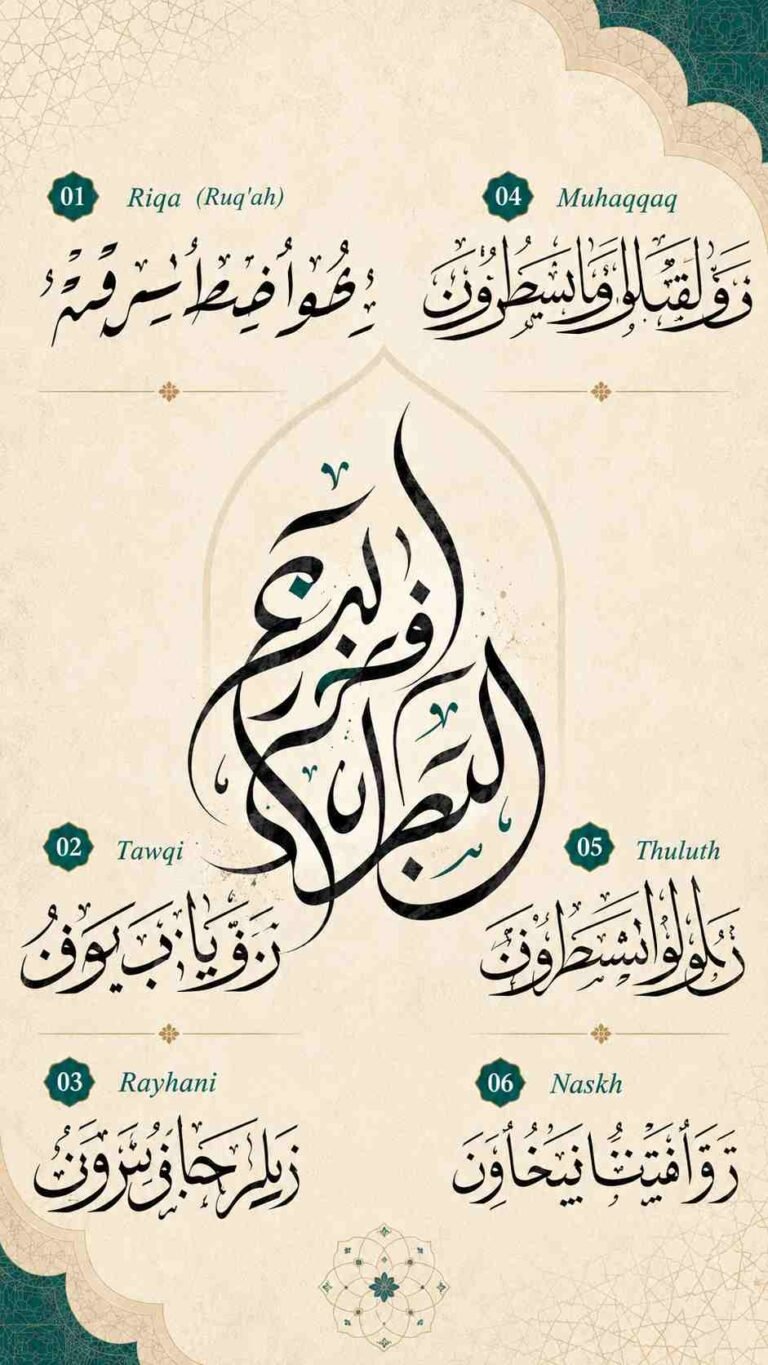
Out of this came al-Aqlam al-Sittah, the Six Pens — six classical scripts still studied today:
- Naskh — rounded and compact, the standard for books and printed text
- Thuluth — tall and dramatic, used for titles and mosque inscriptions
- Muhaqqaq — bold and majestic, reserved for prestigious Qur’ans
- Rayhani — a smaller, more delicate version of Muhaqqaq
- Tawqi’ — developed for official government correspondence
- Riqa’ — compact and quick, closer to everyday handwriting
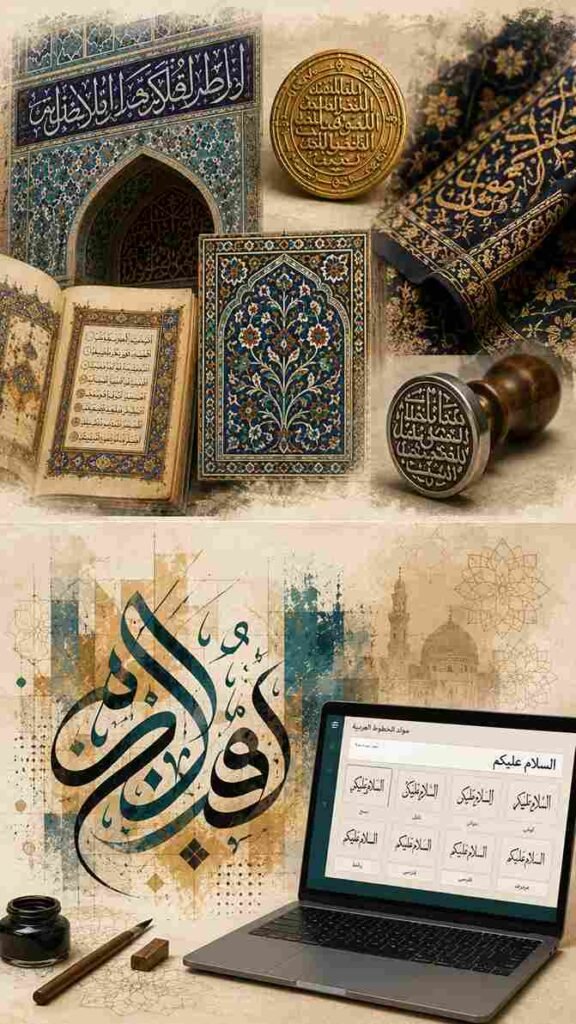
Calligraphy was never confined to paper. It shows up in mosque tilework, on gold and silver coins, woven into royal textiles, framing illuminated manuscripts, and stamped into official seals designed to resist forgery.
Naskh, Thuluth, Muhaqqaq, Rayhani, Tawqi’, and Riqa’ — together known as al-Aqlam al-Sittah, the Six Pens.
The Arabic font generator lets you
The Arabic font generator lets you type or paste Arabic text and preview it instantly across a range of Arabic font styles — modern, traditional Naskh, Kufi-inspired, handwriting and decorative. Adjust the color, background, size and alignment, then download your design as a high-quality PNG or JPG image.
This tool created-paste text tool instead.
Regional Styles
As Islam spread from Spain to India, calligraphy took on local character everywhere it landed.
- Ottoman Istanbul — replaced Baghdad as the calligraphic capital, developing the ornate Diwani script and the Tughra, a sultan’s calligraphic signature
- Persia — developed Nastaliq, with its distinctive sloped, hanging quality suited to Persian and later Urdu poetry
- North Africa and Andalusia — developed Maghrebi script, rounder and heavier than its eastern relatives.
Kufic: The First Great Script
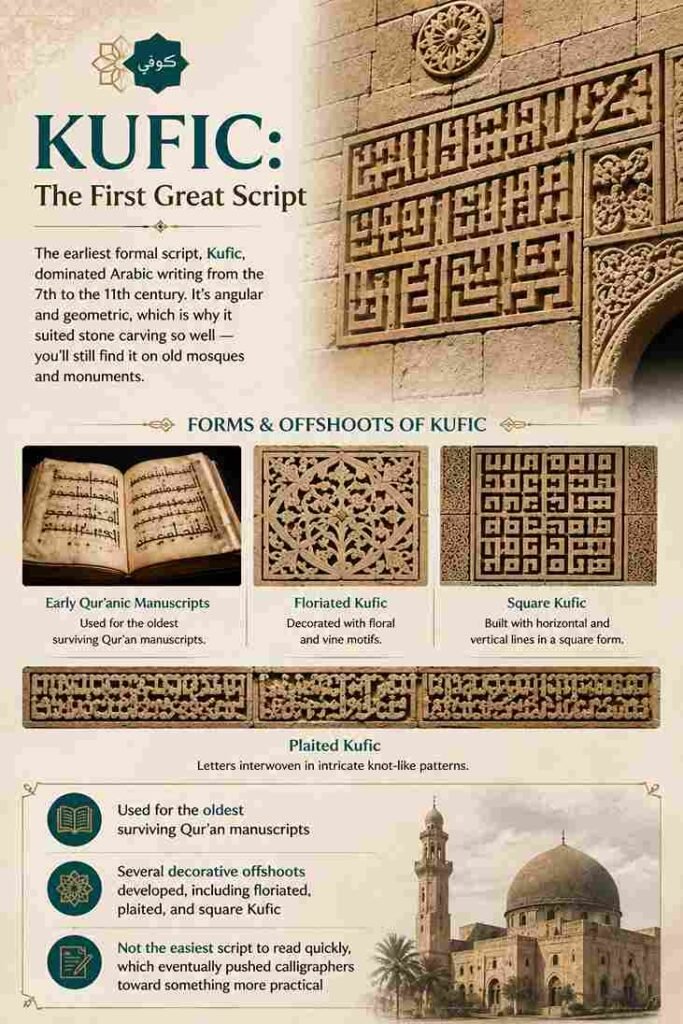
The earliest formal script, Kufic, dominated Arabic writing from the 7th to the 11th century. It’s angular and geometric, which is why it suited stone carving so well — you’ll still find it on old mosques and monuments.
- Used for the oldest surviving Qur’an manuscripts
- Several decorative offshoots developed, including floriated, plaited, and square Kufic
- Not the easiest script to read quickly, which eventually pushed calligraphers toward something more practical
Calligraphy Today
In the mid-20th century, the Hurufiyya movement saw artists lift individual Arabic letters out of their religious and literary context and reimagine them as modern abstract art — a way of expressing cultural identity as many nations gained independence. That same spirit of experimentation continues now with digital typography: designers build fonts that echo Naskh, Kufic, or Thuluth on screen, keeping the same rhythm and proportion alive in pixels instead of ink. If you’re curious how that translates in practice, it’s worth typing a few words into an Arabic font generator and watching those centuries-old shapes take form.
Frequently Asked Questions
What is the oldest Arabic script?
Kufic, dating to the 7th century. It was used for the earliest Qur’an manuscripts before more cursive scripts took over.
Who standardized the classical Arabic scripts?
Ibn Muqla (886–940), whose proportional system was later refined by Ibn al-Bawwab and Yaqut al-Musta’simi.
What are the six classical Arabic scripts?
Naskh, Thuluth, Muhaqqaq, Rayhani, Tawqi’, and Riqa’ — together known as al-Aqlam al-Sittah, the Six Pens.
Is Arabic calligraphy still practiced today?
Yes — traditional calligraphers still train for years under masters, and the art continues to shape modern design, branding, and digital typography.
What's the difference between Naskh and Thuluth?
Naskh is compact and easy to read, which is why it became the go-to script for books and everyday text. Thuluth is taller and more decorative, generally reserved for titles and monumental inscriptions rather than long passages.
What materials did early calligraphers use?
Traditionally, a qalam (reed pen) and hand-mixed ink were the tools of choice, written on parchment, papyrus, or later on paper once papermaking reached the Islamic world in the 8th century.